Wednesday, March 14, 2012

Riva's Quest by Sue Perkins

This is an unusual way to promote a book - the YA author, Sue Perkins, interviews Riva, the main character in her book. Check out the rest of the interview at
Author of The Unhewn Stone

Riva's Quest by Sue Perkins available at Amazon Kindle and MuseItUp Publishing.

Riva's father's job moves them from place to place meaning she frequently changes schools and consequently has no friends. At every school she attends friendships have been in place for years and there is no room for a new girl to join in. Reva withdraws to her imagination and begins to write about the magical world of Fey

Reva: It was funny really. I'd been writing a fantasy book about the land of Fey. Then one night Fey came to life.

Sue: How do you mean "came to life"?

Reva: We hadn't had time to tidy up the garden since we moved in and I'd found a garden gnome half buried in the bottom of the garden. That night the gnome knocked on my window and told me to come with him.

Sue: A garden gnome spoke to you? That's weird. Did you? Go with him I mean.

Reva: Of course I did. Who wouldn't when it provided a bit of excitement in my boring life. His name was Gareth and he took me through the scummy pond where he usually fished. When we came out the other side we were in Fey. Read More
Download The Rainbow Children by Laurel Lamperd at Smashwords


Tuesday, March 13, 2012

Carole Sutton, her latest book, Flash Harry, gives an idea of how she writes her thrillers. How do you write your books? The rest of Carole's interview can be viewed on www.siriuspress.com/interviews
TB: Can you describe your writing process?
CS: A bit disorganized, I’m afraid. I don’t start writing until I have a plot in mind and know how it starts and roughly how it’s going to end, though that tends to change as I progress. I set the plot up with a prologue to start with. If nothing else, that anchors me and gives me a flying start. I make a few notes on each chapter as I come to them on what I want to cover in that chapter so I can monitor how the story is moving forward. I am not a blank screen person – I can’t sit there and wait for the writing to appear. If the muse isn’t working I go off and do something boring, like housework, or ironing—tidying my office doesn’t seem to work!
TB: To what degree are your fictional characters based in reality?
CS: None of my characters are based on any real person, but they do have to be realistic, and recognizably human, as I don’t write fantasy. The good characters have to have some flaws that make them human. And even the bad guy might have loved his mother or something else in his lifetime, so he can’t be all bad. I’m blessed (or cursed) with the devil’s advocate mind. It has caused me much trouble in discussions in the past, but now I find it helpful in giving depth to my characters because I can see both sides of just about any argument.

                                                   Desert country inland Western Australia

Sunday, March 11, 2012

Read free short story Woman in the Blue Dress on www.authorsden,com/laurellamperd & http://laurellamperdwriter.webs.com

What happens when a young man marries an older woman for her money.

Marlene first noticed the woman because she wore the same blue dress as she did. The woman even wore a pearl choker like her. 
She didn't worry seeing another woman in the same dress. In fact, she felt pleased someone had liked it enough to wear. Charles hadn't liked it. He didn't like any of her clothes. He said she'd have to acquire a better dress sense now he was a politician.
She sat by herself in the corner of the room, ignored by the partygoers chatting vivaciously in groups. She hated going with Charles to parties which all the rich and well known attended but she had to because of his position.
She glimpsed him through the crowd talking to a tall blond woman near the double glass doors leading onto the terrace. He looked very handsome. She was proud of him. He was forty-five and looked thirty.

Saturday, March 10, 2012

How do you keep your blog interesting. You might find a few ideas from this excerpt of Susan Bearman contribution to Write It Sideways blog. susannah@writeitsideways.com

Demonstrate your best writing in every post. This is essential. Your blog may be the first exposure a potential reader (or agent or publisher) has to your writing, so do a good job. Think through your post. Make sure you have a beginning, a middle, and an end. Proofread before you post. Better yet, ask a picky friend to proofread for you. Correct mistakes immediately.

If you don’t have anything to say, don’t say it in a post. A stale blog is pointless, but a boring blog is deadly. Keep it fresh by posting regularly, and keep it interesting. Be on the lookout for good ideas. You keep a notebook with you at all times, right? (Your smart phone works just as well.) Start a list of possible posts right now.

A great way to keep your blog fresh is to write several posts at a time and schedule them in advance. For example, write three posts over the weekend and schedule them to go up on Monday, Wednesday, and Friday. Once you start writing, you tend to get into a groove. Writing online usually works better when it’s short, anyway, so you don’t need to worry about writing three chapters of War and Peace every weekend; 200-400 words is plenty.


Monday, March 5, 2012

March Calamity's Corner is now available for free download online.
Read an excerpt from Canadian suspense author, Joylene Butler, energizing article on what it means to be a writer.

How do you maintain your conviction after collecting
a drawer full of rejections? How do you fill that empty
void inside? How do you rid yourself of the negative
inner voice yellng,
I’m a failure.

How do I keep the faith?
When interviewers ask me that, I jokingly reply that I
was too stubborn to quit. But the truth is, I couldn’t.
Even when I had doubts, and I had plenty, I enjoyed
writing too much. Even when it felt like I had quit, I
was actually writing inside my head.
Believe in yourself.
Believe in your ability, and learn everything you can
about your craft. It may take awhile, but your dream
will come true. Keep the faith. You have nothing to
lose.

Reviews of Books and Movies. Travel News. The Galapagos Islands.

Readers are able to participate in Calamity's Corner. Contact Calamity at
calam@live.com.au

Sunday, March 4, 2012

Apricots

Free read at http://laurellamperdwriter.webs.com & www.authorsden.com/laurellamperd
Poem - Apricots - Can love be blind.
Section of a painting from Vincent van Gogh

Saturday, March 3, 2012

The Writer, the Alchemist.

Whether planting characters in a modern romance or trapping them on alien planets,  in prehistoric caves or the Middle Ages, writers create worlds and situations to tell their stories.
                     Some see themselves as gods.
                                           
    I see myself as the Alchemist.


I love symbolism, so it is natural I should gravitate to the art of the ancient alchemists who used physical symbols as metaphors to hide their spiritual philosophies which conflicted with the Medieval Church.                        
As the alchemist, my aim is to create my Opus Magnum or Great Work, so I focus on their three prime elements: sulphur (fire), mercury (water) and salt (form)


 The Alchemist strove to find the right balance between these minerals to produce the sacred elixir (philosopher’s stone) that would transmute base metal into gold and in the process lead him from ignorance to enlightenment. So I strive to do the same.

Ideas bubble and boil in the apparatus in my laboratory. Characters and conflicts fuse into scenes and bake in the self-feeding furnace of my imagination. The result is a jumble of words like chemical experiments. Some work, some don’t, while I seek the sacred elixir, which I call creative juice, to transform chaos into order. To do this I turn to the alchemist’s symbols for direction. 

I become sulphur (the Sun), the omnipresent spirit of life. I am mercury, (the Moon – a passive and imperfect reflection of the sun), I am salt (crystals: impure " purified).

 A particularly fine idea is that salt symbolizes self-knowledge & wisdom. In its lowest form it is bitter and painful. I love that! So I make my characters suffer as they grow in understanding, but I hope I learn something along the way, too.

As Hermes, the swift messenger (Mercury) and Apollo, patron god of the Arts (Sun) I dissolve or coagulate scenes and characters to my heart’s content. There’s plenty of symbolism here to keep me happy and give my stories form. But I use more.

The alchemist believed the Divine world is reflected in a Material world which is corrupted. Only by removing the imperfections can he reveal the true state of matter and show its perfect union with the Divine. For him, the golden sun, represents the Divine (religion) and the silver moon, represents Matter (science). He saw the marriage of the two in the total solar eclipse. It’s a beautiful concept:   
    
            
                                                                          All in One                                      

I try to do the same, by showing both the sacred and secular aspects in everything. Like the self-devouring serpent, the ouroboros, I fuse them together into the circular union of endings and beginnings: goal, crisis, consequence " new goal, crisis etc.


And I must have my staff of Hermes or caduceus wand. This is the symbol of the transforming alchemical power i.e. the transcendence from the profane to the sacred. The union of the two opposing forces in our nature, seen in the coiled snakes rising on the pole. They represent duality – a blending of the positive and negative aspects in my stories.

The Alchemist labours on, dissolving away the imperfections in his metals, trying to purify them so they not only reflect the sun, but reveal Divine Light. Like he who murmurs, ‘Dissolve, dissolve, dissolve,’ I sift through the dross in my chapters, in search of true gold, and delete, delete, delete.

I could spend a lifetime striving and never achieve my lofty goal, but that’s okay. If alchemists had given up, we would have none of their lesser achievements today.

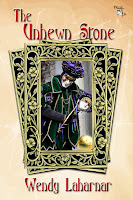
 For The Unhewn Stone, I’m indebted to a fictional 14th C. alchemist for handing me his golden orb which
 reflects the Divine Light of the Sun.


This article first appeared in Calamity's Corner August 2011 and later on Heather Haven's This and That - January 18th 2012.